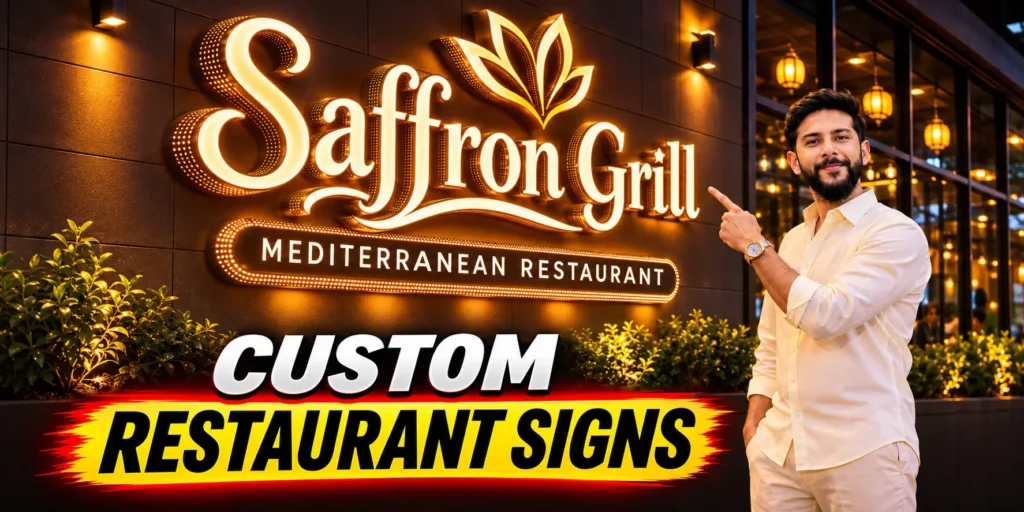
A restaurant’s exterior is often its first opportunity to make an impression. Before customers see the menu or experience the food, they notice the building, entrance, lighting, and signage. Professionally designed custom restaurant signs help restaurants establish a recognizable identity, attract attention, and stand out in competitive commercial locations.
From illuminated 3D letters and stainless steel logos to modern LED storefront displays, restaurant signage combines visual design with practical functionality.
At Antique Signage & Advertising, we manufacture dimensional signage for restaurants, cafés, fast-food businesses, and commercial storefronts. Our work includes custom acrylic letters, metal fabrication, LED illumination, decorative logo signs, and exterior branding for international projects.
This guide explains how modern restaurant signs are designed, manufactured, illuminated, and prepared for installation, with practical examples of what makes a sign effective.
Why Professional Signage Matters for Restaurants
A restaurant sign is more than a name displayed above the entrance. It is part of the customer’s experience and helps communicate the restaurant’s personality.
A brightly illuminated sign with bold colors may suit a fast-food restaurant, while a café might prefer understated lettering and warm-white lighting.
A premium dining restaurant may choose brushed metal letters, soft halo illumination, and a minimalist logo.
These differences help customers understand the character of the business before entering.
Resturent can create a premium storefront appearance with custom lettering and 3D aluminium signs that reflect their brand identity.
Effective restaurant signage can provide several benefits:
- Improve visibility from roads and parking areas.
- Make the business easier to recognize.
- Reinforce consistent brand colors and typography.
- Communicate the restaurant’s identity.
- Improve nighttime visibility.
- Create a more professional storefront appearance.
The most successful signage balances attractive design with clear readability.
Modern Custom Restaurant Signs and Their Popular Styles
Restaurant owners can choose from several dimensional and illuminated signage styles.
Each produces a different effect and suits different building types.
1. Front-Lit 3D Acrylic Letters
Front-lit channel letters are among the most popular choices for commercial restaurants.
They typically feature translucent acrylic faces with fabricated metal or aluminum sides.
LED modules installed inside the letters illuminate the acrylic faces, making the restaurant name visible after dark.
This style works particularly well for fast-food restaurants, takeaway businesses, shopping plazas, and roadside locations.
2. Stainless Steel Halo-Lit Letters
Halo-lit letters produce illumination behind the characters rather than through the front.
Opaque metal faces remain visible while the LED light reflects onto the mounting surface.
This creates a floating appearance and a softer glow.
Halo lighting is especially attractive for premium restaurants, cafés, hotel dining areas, and contemporary food businesses.
3. Glitter and Perforated Metal Letters
Decorative stainless steel lettering can include polished trims, textured finishes, and perforated side returns.
These features add depth and visual interest.
Combined with suitable LED illumination, the letters can create a distinctive appearance that complements colorful restaurant branding.
4. Illuminated Logo Signs
A custom illuminated logo can strengthen brand recognition.
Logos may be produced as individual dimensional elements, lightboxes, or circular signs.
They can also be installed separately from the main restaurant name.
For businesses with recognizable symbols, this provides another way for customers to identify the brand.
How Restaurant Letters Are Manufactured
Professional sign manufacturing involves several stages, beginning with design preparation and ending with testing.
The process should be planned around the approved dimensions, materials, lighting requirements, and installation method.
Stage 1: Artwork and Letter Preparation
The restaurant’s logo and lettering are converted into production-ready vector artwork.
The manufacturer then prepares the letter profiles according to the approved dimensions.
Accurate artwork is particularly important for detailed fonts, logos, and large storefront characters.
Stage 2: Fabricating the Letter Bodies
The front profiles and side returns are manufactured using appropriate cutting and forming equipment.
The returns create the physical depth of the characters.
Their height and shape must remain consistent to give the finished sign a clean appearance.
Stage 3: Installing LED Modules
Once the letter bodies are prepared, the LED modules and wiring can be installed.
The lighting arrangement depends on the dimensions and shape of each letter.
Correct module spacing is essential for producing balanced illumination.
Illustrative example of internal LED module installation in three-dimensional restaurant lettering.
The image demonstrates the internal construction of illuminated letters.
Before the front faces are fitted, the LED modules remain accessible for inspection and electrical testing.
This stage is important because poor wiring or incorrect LED placement can affect the final appearance.
Stage 4: Final Assembly
After electrical preparation, the acrylic faces and other components are fitted.
The finished letters are inspected for alignment, consistent edges, and surface quality.
Stage 5: Illumination Testing
The sign is switched on to inspect brightness and lighting consistency.
Any visible dark spots, failed modules, or irregular illumination should be corrected before dispatch.
Choosing the Right Materials for Restaurant Signage
Materials affect the appearance, weight, durability, and maintenance requirements of the finished sign.
Acrylic, aluminum, stainless steel, and aluminum composite panels are commonly used in commercial signage.
| Material | Main Benefit | Typical Application |
|---|---|---|
| Acrylic | Transmits LED light | Front-lit letter faces |
| Aluminum | Lightweight and versatile | Fabricated channel letters |
| Stainless steel | Premium decorative finish | Metal and halo-lit letters |
| ACM | Smooth, durable backing | Storefront fascia panels |
| PVC | Economical and easy to fabricate | Interior dimensional lettering |
The final material selection should consider the sign’s dimensions and environmental conditions.
A restaurant located in a coastal region may require different protective specifications from one in a sheltered shopping plaza.
How LED Lighting Improves Restaurant Visibility
Lighting allows a restaurant sign to remain effective after sunset.
However, professional illumination depends on more than installing bright LEDs.
The letter depth, module placement, acrylic properties, and electrical system all influence the result.
Warm-White Lighting
Warm-white LEDs create a softer appearance that often complements cafés, bakeries, dessert shops, and premium restaurants.
Cool-White Lighting
Cool-white illumination produces a cleaner, sharper appearance.
It is frequently selected for modern storefronts and businesses that prioritize strong contrast.
Colored LED Lighting
Red, yellow, blue, green, and other lighting colors can be selected according to the approved branding.
The best choice is the one that preserves the restaurant’s recognizable identity without reducing readability.
Restaurant Branding Example: Gyro King
The Gyro King signage project illustrates how dimensional lettering and colorful illumination can support a recognizable restaurant identity.
The design features large yellow letters spelling GYRO KING, a crown-inspired logo, green illuminated elements, and supporting text identifying the restaurant’s food categories.
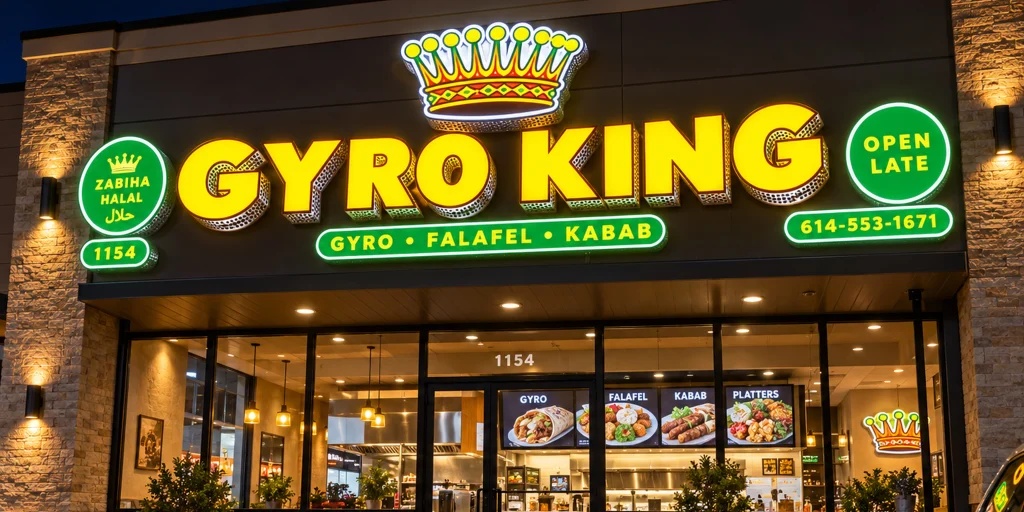
Illustrative storefront presentation of a Gyro King-style illuminated sign, featuring bold yellow lettering and green brand accents.
The combination creates a strong visual hierarchy.
The restaurant name receives the greatest emphasis, while smaller text provides information about the food.
This approach is particularly useful for restaurants located in commercial areas where several businesses compete for customer attention.
The design also demonstrates how supporting elements should complement the main branding rather than overpower it.
Restaurant Signage for Drive-Thru Businesses
Drive-thru signage has additional requirements because customers may need to identify the entrance and service direction while moving through the property.
Large letters, clear directional graphics, and strong contrast are particularly useful.
A drive-thru restaurant may require several coordinated signs, including the main storefront name, entrance direction, ordering point, and collection area.
The primary sign should identify the restaurant clearly.
Directional information should be positioned where drivers actually need it.
For large restaurant projects, the signage layout should be reviewed alongside the building design and traffic circulation plan.
Choosing the Correct Restaurant Sign Size
Sign dimensions should reflect the building proportions and the expected viewing distance.
Small letters may look attractive in a computer mockup but become difficult to read once installed above a large storefront.
Oversized lettering can also overwhelm the building.
The best dimensions balance readability with architectural appearance.
Important factors include the available fascia width, mounting height, letter depth, font style, surrounding signs, and local signage regulations.
A realistic mockup helps business owners review proportions before production begins.
For custom restaurant signs, the size should be selected according to actual site measurements rather than estimated from photographs alone.
Front-Lit vs. Halo-Lit Restaurant Letters
Both lighting methods can create attractive commercial signage, but they produce different effects.
| Feature | Front-Lit Letters | Halo-Lit Letters |
|---|---|---|
| Lighting direction | Through the front | Behind the letters |
| Visual effect | Bright illuminated faces | Soft glowing outline |
| Common faces | Translucent acrylic | Opaque metal |
| Best suited to | High-visibility restaurants | Premium dining and cafés |
| Appearance | Bold and direct | Refined and architectural |
Front lighting is often suitable for restaurants that need strong nighttime visibility.
Halo lighting offers an understated effect that works well for luxury or minimalist branding.
The final decision should consider viewing distance, background material, and the desired brand presentation.
Manufacturing Signs for International Restaurant Projects
International restaurant signage requires coordination between the manufacturer, customer, and installation contractor.
Businesses in the USA, Australia, Canada, the UK, and other countries may have different requirements for illuminated signs.
Before fabrication, the manufacturer should receive approved artwork, final dimensions, electrical specifications, and mounting information.
Local permits and electrical regulations should also be confirmed.
For international projects, accurate drawings and component labeling are especially valuable.
They help the destination installation team position the letters correctly and connect the lighting system.
Packaging and Shipping Custom Restaurant Signs
Dimensional letters require protective packaging because acrylic faces and metal finishes can be damaged during transportation.
Suitable packaging may include protective film, foam separation, reinforced cartons, and custom wooden crates.
The correct method depends on the sign’s construction, dimensions, and weight.
Electrical components should be secured and identified clearly.
For overseas shipments, well-organized packaging can simplify handling and installation while reducing the risk of damage.
Common Mistakes Restaurant Owners Should Avoid
Restaurant signage should be designed for real-world conditions rather than appearance alone.
Common mistakes include choosing lettering that is too small, using insufficient color contrast, adding excessive text, and selecting lighting that does not complement the storefront.
Poor LED spacing can create uneven illumination.
Incorrect mounting methods can also affect structural reliability.
Another mistake is beginning fabrication before confirming the final installation measurements.
A professional design review can identify many of these problems before manufacturing starts.
Frequently Asked Questions
What are custom restaurant signs?
Custom restaurant signs are signage products manufactured according to a restaurant’s particular logo, colors, dimensions, materials, and lighting requirements. They may include 3D acrylic letters, illuminated metal lettering, logo boxes, decorative panels, and directional signs. Unlike standard ready-made products, these signs are developed around the restaurant’s branding and installation location to create a coordinated commercial appearance.
Which type of sign is best for a restaurant storefront?
Front-lit channel letters are a popular choice for restaurants that need strong nighttime visibility. They combine dimensional construction with illuminated acrylic faces. Premium restaurants may prefer stainless steel halo-lit lettering for a softer appearance. The most suitable option depends on the building, brand identity, viewing distance, budget, and local sign regulations.
Are illuminated restaurant signs suitable for outdoor use?
Yes, illuminated signs can be designed for outdoor installation using suitable materials and electrical components. Exterior performance depends on weather protection, mounting hardware, wiring, power supplies, and environmental conditions. The sign should be manufactured according to the intended installation location, with electrical connections completed in accordance with applicable local requirements.
Can restaurant signs be made in different colors?
Yes. Restaurant lettering can be customized using different acrylic colors, metal finishes, and LED lighting systems. Red, yellow, white, green, and blue are common choices for commercial branding. The colors should match the approved restaurant identity while maintaining readability. Lighting tests can help confirm that the illuminated appearance remains consistent with the intended design.
How long do LED restaurant signs last?
The lifespan depends on the quality of the LED modules, power supplies, wiring, materials, operating hours, and environmental exposure. Commercial LED systems can provide years of operation, but individual components may eventually require replacement. Proper electrical design, suitable weather protection, and regular maintenance can help improve reliability and preserve the sign’s appearance.
Can restaurant signs be manufactured for overseas delivery?
Yes. Custom dimensional lettering can be manufactured according to approved drawings and prepared for international shipping. The manufacturer should provide suitable packaging and relevant installation information. Customers should confirm local electrical standards, permits, mounting requirements, and any necessary certifications before ordering, because regulations may differ between countries and cities.
Final Thoughts: Build a Restaurant Brand Customers Remember
A successful restaurant sign brings together clear typography, recognizable colors, suitable materials, and effective illumination.
The best design is not necessarily the largest or brightest. It is the one that communicates the brand quickly and complements the building.
From fabrication and LED installation to quality testing and packaging, each stage contributes to the finished result.
For restaurants, cafés, fast-food businesses, and drive-thru locations, professionally manufactured custom restaurant signs can create a lasting visual identity that supports both daytime recognition and nighttime visibility.
At Antique Signage & Advertising, we focus on turning restaurant branding into carefully fabricated dimensional signage, helping businesses present themselves with a professional and recognizable appearance.