A professional storefront sign is one of the first things customers notice about a business. The right combination of attractive lettering, high-quality materials, brand colors, and lighting can turn an ordinary shopfront into a recognizable commercial identity. For businesses looking for durable and visually appealing signage, 3D aluminium offers an excellent balance of strength, design flexibility, and professional appearance.
At Antique Signage & Advertising, we specialize in manufacturing custom three-dimensional signs for restaurants, drive-thru businesses, retail stores, shopping centers, and commercial properties.
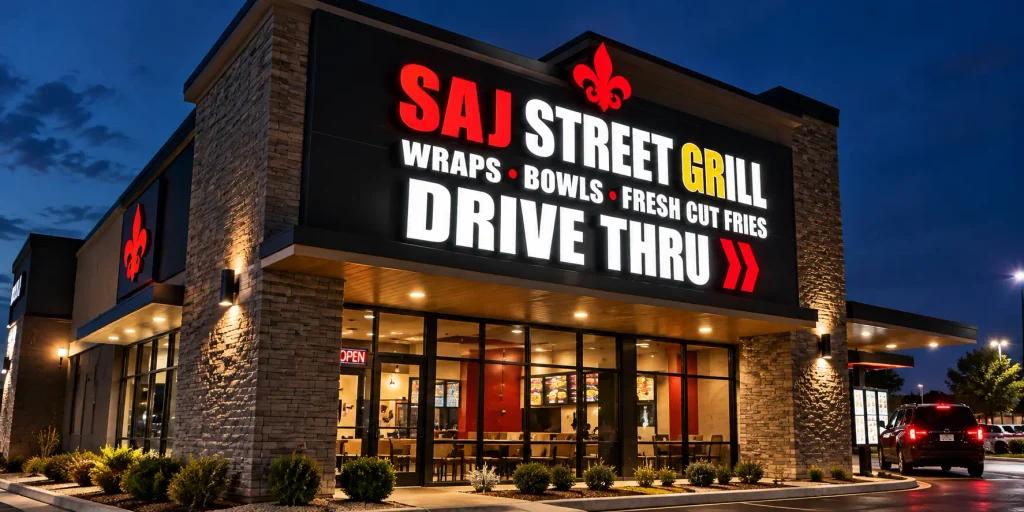
Our completed SAJ Street Grill project demonstrates how dimensional lettering, illuminated acrylic faces, and customized branding can create a strong visual identity.
The project includes bold red, white, and yellow lettering, a distinctive restaurant logo, menu descriptions, and a large illuminated DRIVE THRU display. Each element was designed to support the restaurant’s branding while maintaining excellent readability.
This guide explores the fabrication process, material advantages, illumination methods, design considerations, and practical applications of aluminium-based signage.
What Is 3D Aluminium Signage?
3D aluminium three-dimensional aluminium signage refers to raised letters, logos, and custom shapes manufactured using aluminium as a structural or decorative material.
Unlike traditional flat signboards, dimensional letters extend outward from their mounting surface. This creates physical depth and gives the sign a stronger architectural appearance.
These signs can be manufactured with or without lighting, depending on the business requirements.
Illuminated versions frequently combine fabricated aluminium sides with translucent acrylic faces and internal LED modules. This construction is also commonly known as channel lettering.
A typical illuminated sign may contain:
- Aluminium returns: Form the sides and depth of individual letters.
- Acrylic faces: Allow light to pass through the front surface.
- LED modules: Provide internal illumination.
- Backing components: Support the letters and electrical system.
- Power supplies: Deliver suitable electrical power.
- Mounting hardware: Secure the finished signage to the building.
One of the biggest advantages of dimensional aluminium signage is its flexibility. Businesses can customize the font, size, color, finish, letter depth, and illumination style according to their brand identity.
Our SAJ Street Grill Signage Project
The SAJ Street Grill project provides a practical example of how large commercial lettering can be developed for a restaurant and drive-thru business.
The signage uses a clear visual hierarchy that separates the restaurant name, product categories, and drive-thru service.
The primary branding features SAJ STREET GRILL, with the word SAJ produced in bold red, STREET in white, and GRILL using white and yellow accents.
Below the main name, smaller dimensional letters display:
WRAPS • BOWLS • FRESH CUT FRIES
The lower section features large DRIVE THRU lettering accompanied by red directional elements.
This arrangement makes the restaurant name prominent while keeping the supporting information organized and readable.
Color contrast plays an important role. The red lettering attracts attention, while the white illuminated characters provide strong visibility after dark.
Stage 1: Preparing and Fabricating the Letters
A successful illuminated sign begins with accurate measurements and properly prepared design files.
Before fabrication, the approved artwork is converted into production-ready vector files. These allow the manufacturer to preserve the correct shape and dimensions of every character.
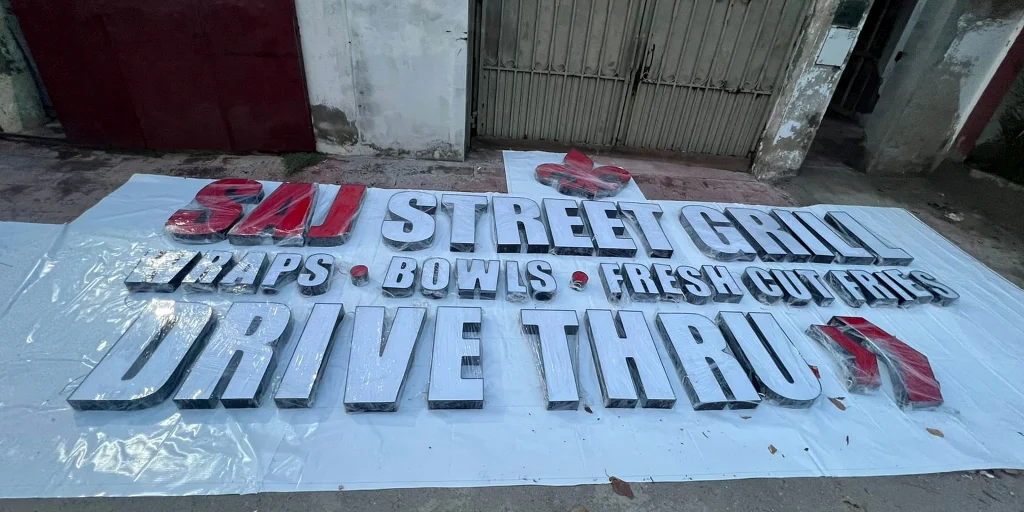
For the SAJ Street Grill 3D aluminium project, the individual letters and decorative elements were prepared separately before final installation.
Cutting the Letter Profiles
The front profiles are prepared according to the approved artwork using suitable cutting equipment.
Accuracy is particularly important for large lettering because small inconsistencies become more noticeable when characters are positioned next to one another.
Letters such as those used in DRIVE THRU require consistent height, stroke width, and spacing to maintain a professional appearance.
Forming the Aluminium Sides
The side profiles, commonly called returns, give each letter its physical depth.
They are shaped to follow the contours of the design.
Straight characters are generally simpler to manufacture, while curved letters and decorative shapes require additional bending precision.
Well-formed returns produce clean edges and consistent depth throughout the sign.
Preparing the Acrylic Faces
For front-illuminated signage, acrylic is commonly used to create the visible letter faces.
The acrylic allows the internal LED 3D aluminium light to pass through while maintaining the required color.
The material must be cut accurately to fit the letter body.
Poorly fitted acrylic can create unwanted gaps, uneven edges, and inconsistent illumination.
Why 3D Aluminium Is Popular for Commercial Signs
Aluminium is widely used in commercial signage because it combines relatively low weight, good corrosion resistance, and fabrication flexibility.
Compared with heavier metals, aluminium can reduce the overall weight of dimensional letters.
This is particularly useful for larger storefront displays where numerous letters must be mounted across a building fascia.
Lightweight Construction
Aluminium provides useful structural properties without adding unnecessary weight.
The final weight depends on material thickness, letter size, and the complete construction.
Custom Finishes
Aluminium can be finished in various colors and surface treatments, including powder coating.
This allows manufacturers to match brand colors and produce a consistent appearance across different signage elements.
Corrosion Resistance
Aluminium naturally develops a protective oxide layer that helps resist corrosion.
However, suitable finishes, fabrication methods, and maintenance remain important, especially for signs exposed to challenging environments.
Design Flexibility
Aluminium can be formed into many letter styles and custom shapes, making it suitable for branding that includes logos, symbols, and unusual typography.
These characteristics make it a practical choice for commercial signage requiring dimensional construction and long-term visual appeal.
Stage 2: Installing the LED Lighting System
Once the structural components have been fabricated, the lighting system can be prepared.
In internally illuminated lettering, LED 3D aluminium modules are installed behind translucent acrylic faces.
The objective is to distribute light evenly rather than simply maximize brightness.
Different letters require different LED arrangements.
Wide characters may need additional modules, while narrow letters require careful positioning to avoid overly bright sections.
Achieving Even Illumination
Three factors strongly affect lighting quality:
- Letter depth: Determines the distance between the LEDs and acrylic face.
- LED spacing: Influences brightness distribution.
- Acrylic diffusion: Affects how smoothly light passes through the front.
If LED modules are positioned incorrectly, visible dots or dark spots may appear.
Professional illumination requires an appropriate balance between these elements.
Electrical Components
LED signs require suitable wiring and correctly sized power supplies.
The electrical system should be designed according to the total connected LED load.
For exterior installations, protection against moisture, dust, and other environmental conditions is especially important.
Stage 3: Assembling the Complete Restaurant Sign
After the letters and electrical components are prepared, the individual elements can be reviewed as a complete signage system.
This includes checking their proportions, colors, finishing, and arrangement.
For SAJ Street Grill, the layout is divided into several levels.
The restaurant name occupies the upper area and receives the most visual emphasis.
The supporting menu categories appear underneath in smaller lettering.
The large DRIVE THRU wording provides a separate service message.
This hierarchy helps customers understand the sign quickly.
A common mistake in storefront design is treating all text as equally important. When every line uses the same size and visual weight, the sign can become difficult to read.
The SAJ Street Grill arrangement demonstrates how different letter sizes can be combined while maintaining a coordinated design.
Stage 4: LED Testing and Nighttime Appearance
Before illuminated signage is dispatched or installed, the complete lighting system should be tested.
This is one of the most valuable quality-control stages because it reveals problems that may not be visible while the sign is switched off.
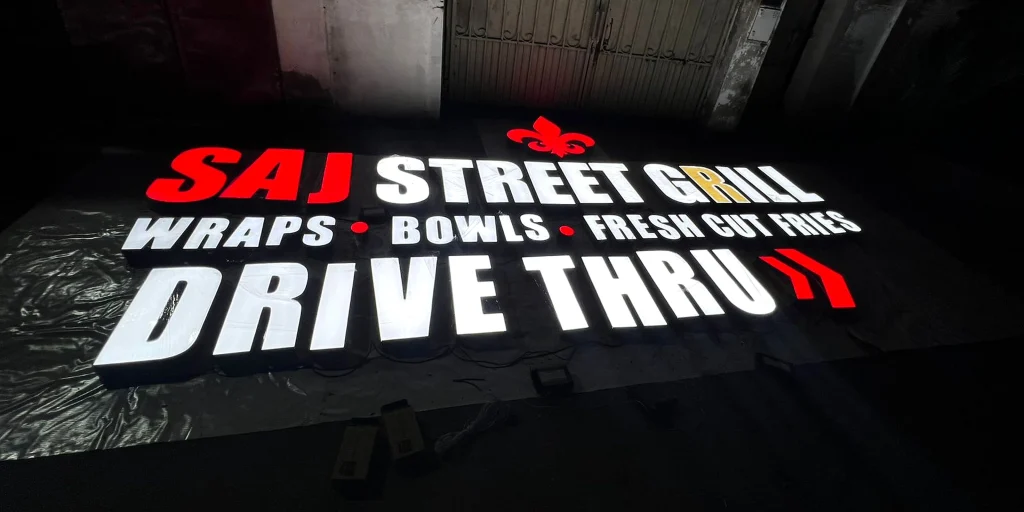
The completed lighting test shows the contrast between the different colors.
The red SAJ lettering creates an immediate focal point.
White lettering enhances the readability of the supporting text and DRIVE THRU message.
The yellow accent adds another recognizable part of the brand identity.
What Is Checked During Testing?
The inspection generally covers:
- LED brightness
- Electrical connections
- Color consistency
- Dark areas or visible hot spots
- Acrylic illumination
- Power-supply functionality
- Operation of all individual letters
Testing before shipping helps identify and correct issues while the signage is still accessible in the workshop.
Daytime and Nighttime Visibility
One advantage of dimensional lettering is that it produces two different visual experiences.
During daylight, customers see the physical structure, colors, edges, and letter depth.
The dimensional construction creates natural shadows that help separate the lettering from its background.
At night, illumination becomes more important.
Internally illuminated acrylic faces produce a bright appearance that can make the business name easier to recognize.
For restaurants operating in the evening, this visibility is particularly useful.
However, lighting should be balanced rather than excessively bright. Uneven illumination or uncomfortable glare can weaken an otherwise professional design.
Different Types of Aluminium Lettering
Aluminium signage can be produced using several construction and illumination methods.
The best option depends on the building, brand identity, and required visual effect.
| Letter Type | Visual Effect | Common Application |
|---|---|---|
| Front-lit | Illuminated acrylic face | Restaurants and retail stores |
| Halo-lit | Light reflected behind letters | Premium boutiques and offices |
| Dual-lit | Front and rear illumination | High-impact commercial signs |
| Non-illuminated | Raised letters without internal lighting | Interior and externally lit signage |
| Solid-looking fabricated letters | Dimensional metal appearance | Corporate and architectural branding |
Front-lit signage is especially effective where strong direct visibility is required.
Halo illumination produces a softer glowing outline and is often preferred for understated branding.
Non-illuminated dimensional letters can be a suitable alternative when internal lighting is unnecessary.
Selecting the Right Letter Depth
Letter depth affects both appearance and lighting performance.
Deep letters create a stronger three-dimensional effect, but they also require appropriate structural design.
The ideal depth depends on the letter size, font, viewing distance, lighting arrangement, and intended installation method.
For internally illuminated lettering, the depth must allow the LEDs to distribute light across the acrylic face.
Insufficient depth can contribute to uneven illumination.
Excessive depth may make some designs look bulky.
This is why letter depth should be planned during the fabrication drawing stage rather than selected only for appearance.
Choosing Colors for Business Branding
Color selection plays a major role in how effectively a sign communicates its brand.
SAJ Street Grill uses red, white, and yellow to create strong contrast.
For restaurants and food businesses, bold colors can help create recognition and make lettering easier to distinguish.
Other commercial categories may require different approaches.
Jewelry retailers often favor gold, champagne, silver, or warm-white combinations.
Medical clinics may prefer white, blue, or green.
Corporate offices frequently use more restrained colors that match their architectural identity.
Rather than choosing colors independently, the signage should complement the approved brand palette and building exterior.
Where Can Dimensional Aluminium Signs Be Used?
Custom aluminium lettering is suitable for a wide range of commercial environments.
Common applications include restaurants, cafés, drive-thru businesses, shopping malls, supermarkets, jewelry stores, pharmacies, salons, automotive showrooms, fitness studios, medical clinics, and corporate offices.
Each business category has different requirements.
A restaurant located beside a busy road may need larger illuminated letters.
A premium boutique may prioritize subtle lighting and decorative finishes.
A corporate building may require consistency across multiple exterior and interior signs.
The ability to customize the construction makes dimensional aluminium lettering suitable for these different applications.
Aluminium Signage vs. Traditional Flat Signboards
Businesses often compare dimensional lettering with conventional flat signage before deciding on a design.
Both can be effective, but they serve different purposes.
| Feature | Dimensional Aluminium Signs | Flat Printed Signboards |
|---|---|---|
| Construction | Raised and three-dimensional | Usually flat |
| Appearance | Architectural and dimensional | Graphic-based |
| Lighting | Optional integrated LED illumination | Optional backlighting |
| Customization | Shapes, depth, finish, lighting | Printed colors and graphics |
| Initial investment | Often higher | Frequently lower |
| Main purpose | Long-term business identity | Branding and promotional graphics |
Flat signage is useful for large printed images, detailed graphics, and promotional information.
Dimensional signage is particularly effective for permanent business names and logos.
Some storefronts benefit from combining both methods.
International Manufacturing and Shipping Considerations
Custom commercial signage can be manufactured for projects in different countries, including the United States, Australia, Canada, the United Kingdom, and European markets.
However, international projects require careful technical preparation.
Before manufacturing, the client and fabricator should confirm the approved dimensions, artwork, electrical requirements, mounting method, and destination regulations.
Different countries and cities may have different requirements for illuminated signs.
These can include permits, electrical certification, building approval, and structural considerations.
For international projects, accurate fabrication drawings and installation information are especially useful.
They help the local installation team understand the complete sign design.
Packaging and Transportation
Large dimensional letters require protective packaging during transportation.
Acrylic faces can become scratched if they are not separated correctly.
Fabricated metal sides may also be damaged by excessive pressure or movement.
Suitable packaging may include protective film, foam sheets, individual wrapping, reinforced cartons, and crates.
The required method depends on the size, weight, and construction of the signage.
Electrical components should also be protected against impact.
For multi-letter signs, individual components should be labeled so they can be identified during installation.
Proper packaging helps preserve the appearance of the finished sign throughout the shipping process.
Installation and Mounting Requirements
A professional sign requires accurate installation to maintain its appearance and safety.
The mounting system should be designed around the building structure and the weight of the letters.
Important considerations include the installation height, facade material, wind exposure, wiring access, and available electrical supply.
Where individual letters are installed separately, a mounting template can help maintain correct spacing.
Exterior signs should also be installed according to applicable local regulations.
Suitable electrical protection and service access should be considered before installation begins.
Maintenance and Long-Term Performance
Even high-quality illuminated signs require occasional inspection and maintenance.
Outdoor signage may accumulate dust, pollution, and other environmental debris.
Cleaning methods should be compatible with the acrylic and metal finishes.
Electrical components may eventually require servicing or replacement.
The overall lifespan depends on component quality, installation conditions, operating hours, and maintenance.
For 3D aluminium, appropriate coatings, secure mounting, and well-designed electrical systems can contribute to dependable long-term performance.
Planning for maintenance during fabrication helps reduce unnecessary complications later.
Common Mistakes to Avoid When Ordering Custom Signs
One common mistake is selecting letter dimensions based only on a computer mockup.
Actual viewing distance and building proportions can change how the sign appears.
Another mistake is choosing colors without considering the background.
Insufficient contrast can make even large letters difficult to read.
Uneven LED spacing can produce dark areas or visible light points.
Poor electrical protection can create problems in exterior environments.
Weak packaging and incomplete mounting information may also complicate delivery and installation.
These problems can often be prevented through accurate drawings, material planning, and quality-control checks.
Frequently Asked Questions
What is 3D aluminium used for in business signage?
3D aluminium is used to manufacture dimensional letters, logos, and fabricated sign components. It is commonly selected for commercial storefronts because of its relatively low weight, corrosion resistance, and flexibility in fabrication. Illuminated versions can combine aluminium sides with acrylic faces and LED lighting. The exact construction depends on the desired appearance, sign dimensions, and installation conditions.
Can aluminium signs be illuminated with LED lights?
Yes. Fabricated aluminium letters can be designed with internal LED modules and translucent acrylic faces. The light passes through the acrylic to create the illuminated effect. Other designs use rear-facing LEDs to produce halo lighting. The appropriate system depends on letter depth, material selection, brand colors, and required visibility.
Are aluminium letters suitable for outdoor installation?
Yes, appropriately designed aluminium letters are widely used for exterior commercial signage. Aluminium offers good corrosion resistance, but the complete sign must also use suitable coatings, structural supports, weather-resistant electrical components, and mounting hardware. Environmental conditions such as rain, wind, temperature, and sunlight should be considered before manufacturing.
What is the difference between aluminium and stainless-steel signage?
Aluminium is generally lighter and is commonly used for dimensional commercial lettering. Stainless steel is often selected for particular decorative finishes and premium architectural applications. Both materials can provide durable results when fabricated correctly. The final choice depends on weight requirements, budget, environmental exposure, desired appearance, and structural specifications.
How long do illuminated aluminium signs last?
The service life depends on material quality, LED modules, power supplies, electrical design, environmental conditions, and maintenance. Commercial LED components can operate for many years, although their performance may gradually decline. Appropriate electrical loading, weather protection, and accessible maintenance arrangements can help improve the long-term reliability of illuminated signs.
Can custom aluminium letters be shipped internationally?
Yes. Dimensional aluminium letters can be manufactured according to approved designs and prepared for international transportation. Proper packaging helps protect acrylic faces, fabricated metal sections, and electrical components. Customers should confirm electrical requirements, mounting specifications, permits, and any necessary certifications in the destination country before production.
Are dimensional aluminium signs better than traditional signboards?
They serve different purposes. Dimensional signs provide physical depth and can incorporate individually illuminated letters, creating a premium storefront appearance. Traditional printed signs are often more economical and suitable for detailed graphics. The better option depends on the business identity, budget, installation location, and whether illuminated dimensional branding is required.
Final Thoughts: Build a Stronger Business Identity
The SAJ Street Grill project demonstrates how dimensional construction, carefully selected colors, accurate fabrication, and professional LED illumination can work together to create a recognizable restaurant sign.
From preparing individual letter profiles to arranging the lighting system and conducting final quality checks, each manufacturing stage contributes to the finished result.
For restaurants, drive-thru locations, shopping centers, and other commercial businesses, 3D aluminium offers a versatile signage solution that combines modern design with practical fabrication benefits.
At Antique Signage & Advertising, we focus on creating custom signs that reflect the character of each business through thoughtful design, suitable materials, and careful manufacturing.
A well-made sign does more than identify a location. It helps customers recognize the brand, find the business, and remember it long after they have passed the storefront.