A professionally designed outdoor sign board is more than a display of a company name. It creates the first impression of a business, strengthens brand recognition, and helps customers identify a location from a distance. The right combination of dimensional lettering, premium materials, attractive finishes, and LED lighting can transform an ordinary building into a recognizable commercial identity.
At Antique Signage & Advertising, we manufacture custom business signage designed to combine architectural appearance with practical construction.
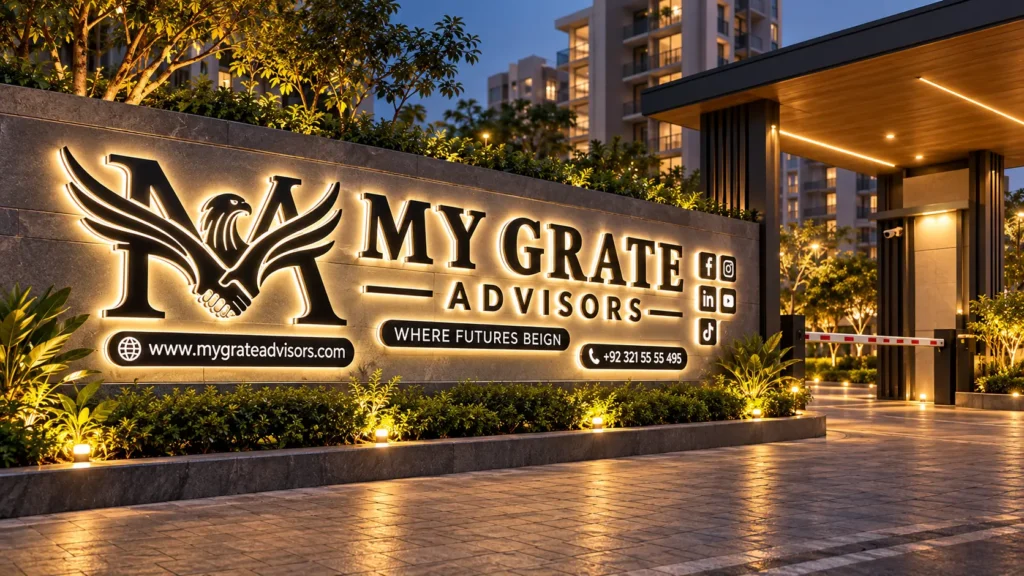
Our MY GRATE ADVISORS signage project demonstrates how raised metal-style lettering, an elaborate winged logo, metallic finishes, and soft halo illumination can work together to create an elegant professional identity.
The project features large dimensional letters, contrasting gold-toned supporting text, a distinctive emblem, and illuminated branding elements.
This guide explores the manufacturing process, materials, lighting techniques, design considerations, and practical benefits of professional exterior signage.
What Is a 3D Halo-Lit Outdoor Sign?
Halo-lit signage uses raised three-dimensional letters with LED lighting positioned behind the characters.
Unlike conventional front-lit letters, where light passes through an acrylic face, halo-lit lettering creates illumination around the outside of each character.
LED modules project light onto the background surface, producing a soft glowing outline.
This creates an attractive floating-letter appearance.
The technique is particularly popular for corporate offices, real estate companies, educational institutions, luxury retailers, professional service businesses, and premium commercial properties.
Main Components
A typical halo-lit dimensional sign includes:
- 3D fabricated letters: Create the physical depth and shape.
- Metal faces and returns: Provide the dimensional appearance.
- LED modules: Produce the rear illumination.
- Mounting spacers: Maintain the required distance from the background.
- Electrical wiring: Connect the lighting system.
- Power supplies: Provide electricity to the LED modules.
- Mounting structure: Secures the completed sign.
Stainless steel is often selected for premium dimensional lettering, although aluminium and other suitable materials can also be used.
The exact material should be confirmed from the approved fabrication specifications.
MY GRATE ADVISORS: Our Custom Signage Project
The MY GRATE ADVISORS project demonstrates how dimensional signage can communicate professionalism through carefully selected lettering, proportions, and illumination.
The main branding includes a large decorative winged emblem, bold company lettering, contrasting secondary elements, and a supporting tagline.
The design incorporates:
- Large raised black letters
- Gold-toned dimensional lettering
- A prominent winged brand symbol
- Rear LED illumination
- Supporting company information
- The tagline WHERE FUTURES BEGIN
- Custom three-dimensional fabrication
The visual hierarchy gives the company name priority while allowing the supporting elements to remain readable.
The design also emphasizes the logo, which helps create a distinct brand identity.
Stage 1: Preparing the 3D Letters and Logo
Professional sign manufacturing begins with accurate artwork and planning.
Before fabrication, the approved design is prepared in vector format so the letters and logos retain their proportions when scaled to the required dimensions.
Each component must be measured carefully to ensure the finished sign matches the approved layout.
Preparing the Letter Profiles
The manufacturing team follows the approved artwork to produce individual character profiles.
Large letters require particularly careful measurement because even small differences in proportions can become noticeable once the full sign is assembled.
The letter height, width, stroke thickness, and spacing must work together.
Fabricating the Dimensional Structure
Three-dimensional letters can be manufactured using fabricated metal construction.
The returns form the sides of the characters, creating the required depth.
Curved letters and decorative logo elements require additional shaping precision.
The winged emblem in this project is particularly important because it contains several fine curves and layered visual details.
Surface Finishing
The finished appearance of the letters depends on the selected material and coating.
Common options include powder-coated black, brushed metal, polished stainless steel, and gold-toned finishes.
For exterior use, finishes should be selected according to the local environment, expected exposure, and maintenance requirements.
Stage 2: Assembling and Reviewing the Complete Sign
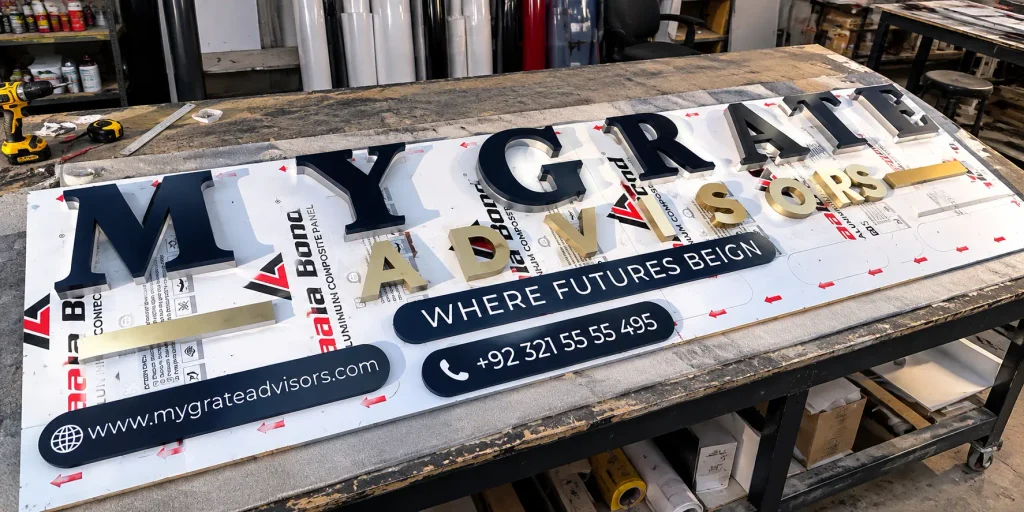
After the individual letters and decorative components have been prepared, the full arrangement can be checked.
This stage helps the fabrication team confirm the spacing, alignment, and overall propor
The complete layout reveals how the different elements work together.
The large emblem creates a focal point, while the main company name establishes the brand identity.
Supporting text is positioned separately to prevent the sign from becoming overcrowded.
Why Alignment Matters
Incorrect spacing can make even expensive lettering appear unprofessional.
Letters positioned too closely may be difficult to read, while excessive gaps can weaken the visual connection between characters.
Logo alignment also needs careful attention.
An accurately prepared installation template helps preserve the intended arrangement.
Why an Outdoor Sign Board Needs Strong Visual Hierarchy
An outdoor sign board should communicate the most important information within seconds.
People passing a commercial property rarely stop to examine every detail.
The main business name should therefore receive greater emphasis than secondary information such as phone numbers, websites, and taglines.
The MY GRATE ADVISORS design follows this approach.
The winged emblem establishes a recognizable symbol.
Large company lettering communicates the name.
The tagline adds a supporting message without competing with the primary branding.
This approach works particularly well for professional service companies, advisory firms, commercial offices, and educational institutions.
Stage 3: Final LED Installation and Night Testing
Once the dimensional components and electrical connections are prepared, the illuminated elements can be tested.
Lighting tests are essential because problems may become visible only after the LEDs are switched on.
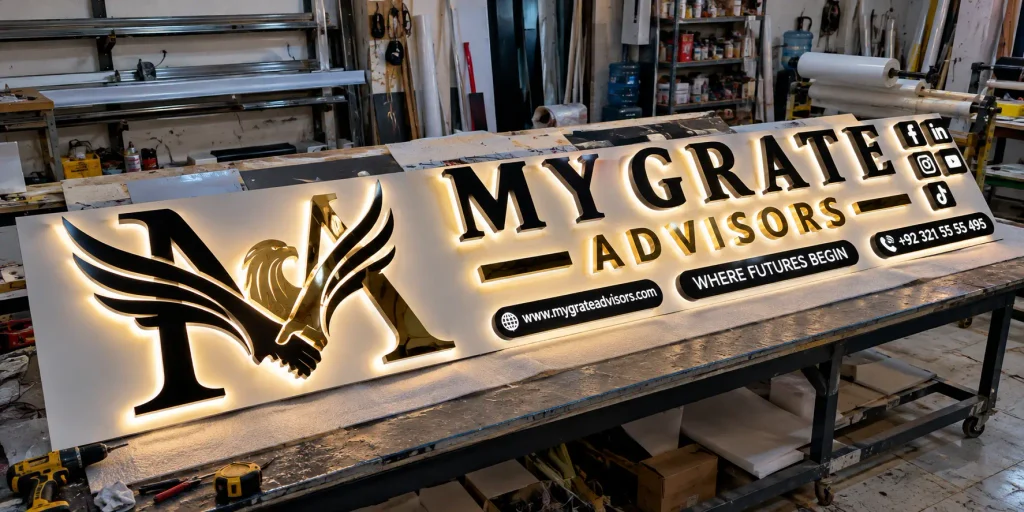
The lighting test demonstrates the difference between ordinary dimensional lettering and illuminated architectural signage.
The dark letter faces remain visually solid while the white light appears around their edges.
This creates additional depth and separates the lettering from the background.
What Is Checked During Testing?
The fabrication team should inspect:
- LED operation
- Brightness consistency
- Electrical connections
- Uneven lighting
- Dark areas
- Mounting clearance
- Power-supply performance
- Overall visual appearance
Testing before dispatch helps identify faults while the sign remains accessible.
How Halo Lighting Works
Halo lighting depends on the relationship between the LED modules, the letter body, and the mounting surface.
LED modules are positioned behind the opaque characters.
A controlled gap allows the light to spread across the background.
The reflected illumination becomes visible around the letter edges.
Three factors strongly influence the final effect.
Distance From the Background
If the letters are positioned too close to the wall, the halo may appear narrow.
Increasing the mounting distance can create a wider illuminated effect.
However, too much separation may reduce the definition of the glow.
Background Surface
Light-colored surfaces generally reflect more light than darker surfaces.
A smooth background can produce more consistent illumination.
Highly textured materials may scatter the light unevenly.
LED Positioning
Modules must be positioned according to the shape and dimensions of each character.
Poor spacing can produce unwanted bright patches or areas of inconsistent illumination.
Choosing the Right Materials for Exterior Signage
Material selection affects appearance, durability, weight, and maintenance requirements.
Different materials offer different advantages.
| Material | Main Advantage | Common Use |
|---|---|---|
| Stainless steel | Premium finish and corrosion resistance | Luxury and corporate lettering |
| Aluminium | Lightweight and versatile fabrication | Commercial dimensional signs |
| Acrylic | Light transmission and precise shaping | Illuminated letter faces |
| ACM panels | Smooth cladding and backing surfaces | Signboard backgrounds |
| PVC | Easy fabrication and economical construction | Interior dimensional signage |
The correct combination depends on the intended installation environment.
An exposed coastal storefront may require different protective measures from an indoor office reception sign.
For large exterior projects, structural considerations and appropriate fixing methods are especially important.
Halo-Lit vs. Front-Lit Signage
Different illumination methods produce different appearances.
| Sign Type | Lighting Effect | Suitable Applications |
|---|---|---|
| Halo-lit | Soft glow behind letters | Corporate offices and premium brands |
| Front-lit | Light shines through letter faces | Restaurants and retail storefronts |
| Dual-lit | Front and rear illumination | High-impact commercial signage |
| Non-illuminated | Raised lettering without internal LEDs | Interior branding and architectural signs |
Halo-Lit Letters
These provide an elegant, understated appearance.
They are frequently used for corporate branding and premium commercial environments.
Front-Lit Letters
These produce stronger direct illumination through translucent acrylic faces.
They are often selected for restaurants, shopping centers, and roadside retail locations.
Dual-Lit Letters
Dual-lit designs combine both lighting techniques to produce additional visual depth.
The final choice should depend on the brand identity, viewing distance, installation surface, and required brightness.
Selecting the Correct Letter Dimensions
A sign should be designed according to how customers will actually view it.
Letter dimensions that look balanced on a computer screen may behave differently when installed several meters above ground.
Important factors include:
- Building width
- Available fascia height
- Viewing distance
- Traffic direction
- Mounting position
- Letter proportions
- Lighting conditions
- Nearby architectural obstacles
Large commercial signs should be reviewed using accurate dimensions rather than visual estimates.
For an outdoor sign board, a clear business name is generally more valuable than excessive supporting text.
Why Businesses Choose Dimensional Metal Signs
Three-dimensional metal lettering offers several practical and visual advantages.
Premium Brand Presentation
Raised letters create a more substantial appearance than ordinary flat graphics.
Daytime Visibility
The physical depth creates natural shadows and helps the lettering stand out.
Nighttime Recognition
LED illumination keeps the branding visible after daylight disappears.
Customization
Letters and logos can be manufactured in different dimensions, styles, and finishes.
Architectural Integration
Dimensional signs can complement modern facades, stone cladding, metal panels, and commercial building designs.
The final result depends on thoughtful design and accurate fabrication rather than simply selecting expensive materials.
Applications Across Different Industries
Halo-lit dimensional signage is suitable for many business categories.
Common applications include corporate offices, consulting firms, real estate companies, educational institutions, luxury boutiques, jewelry stores, architectural practices, financial services, wellness studios, and premium retail properties.
The required visual effect varies by industry.
A corporate office may prefer black lettering with neutral-white halo illumination.
A luxury boutique may use brushed metallic finishes with warm-white lighting.
An educational consultancy may prioritize a distinctive emblem and clear company name.
These variations allow the same construction principles to support different brand identities.
Electrical Safety and Outdoor Protection
Illuminated signage is also an electrical installation.
The LED modules, wiring, connectors, and power supplies must be appropriate for the operating environment.
Outdoor signs require particular attention to environmental protection.
Moisture intrusion, poor wiring connections, and incorrectly sized power supplies can reduce reliability.
The installation should also provide reasonable access for future servicing.
Where required, qualified electrical professionals should complete the electrical connections according to applicable local regulations.
For international projects, electrical and building requirements may vary between countries and cities.
Installation and Mounting Considerations
Professional installation is essential for maintaining both appearance and structural safety.
Halo-lit letters need consistent mounting clearance.
Uneven separation from the background can create inconsistent lighting around different characters.
A suitable installation template helps maintain the correct alignment.
The mounting system must also be compatible with the building material.
Stone, metal cladding, concrete, and composite panels may require different fixing methods.
The final installation should be inspected during daylight and after dark to confirm the intended appearance.
Packaging and International Shipping
Custom dimensional signage may be manufactured in one location and installed in another.
This makes packaging particularly important.
Metal finishes can become scratched during transport.
Large letters may also be damaged if they are allowed to move inside the packaging.
Depending on the construction, suitable packaging may involve protective wrapping, foam separation, reinforced cartons, and custom crates.
Individual letters should be labeled where necessary to simplify installation.
Customers ordering internationally should also confirm mounting specifications, electrical requirements, and applicable local approvals before production.
Maintenance and Long-Term Performance
A well-fabricated sign can provide years of service, but occasional maintenance remains important.
Exterior surfaces may accumulate dust and pollution.
Appropriate cleaning methods help maintain the appearance of the metal finish.
Electrical components should be inspected when necessary.
LED modules and power supplies may eventually need servicing or replacement.
The useful lifespan depends on component quality, environmental conditions, operating hours, and maintenance.
Accessible construction can make future servicing easier and reduce unnecessary dismantling.
Common Mistakes to Avoid
Several mistakes can reduce the effectiveness of an illuminated sign.
Poor letter spacing may create overlapping halos.
Incorrect mounting distances can produce uneven illumination.
Unsuitable materials or coatings may deteriorate in exterior conditions.
Weak wiring connections can cause electrical problems.
Small lettering may become unreadable from the intended viewing distance.
Another common mistake is including excessive text on the main fascia.
Clear branding, suitable materials, accurate drawings, and professional testing help prevent these issues.
Frequently Asked Questions
1. What Is an Outdoor Sign Board Used For?
An outdoor sign board identifies a business and makes its location easier for customers to recognize. Depending on the design, it may include dimensional lettering, illuminated logos, brand colors, and supporting information. Exterior signs are widely used by shops, restaurants, offices, institutions, and commercial buildings. The best design depends on viewing distance, building architecture, lighting requirements, and the business identity.
2. What Are SS Halo-Lit 3D Letters?
SS halo-lit letters are three-dimensional stainless-steel letters designed with rear LED illumination. The light shines onto the mounting surface behind the characters, creating a glowing outline. Their front faces generally remain opaque. This lighting method produces an elegant appearance and is commonly selected for corporate offices, luxury stores, professional businesses, and architectural branding.
3. Are Halo-Lit Signs Suitable for Outdoor Installation?
Yes, provided the sign is designed using suitable exterior materials, electrical components, coatings, and mounting hardware. Outdoor performance depends on the entire construction rather than the letters alone. Weather exposure, moisture protection, wiring, wind conditions, and local regulations should be considered before manufacturing. A qualified installer should verify the mounting and electrical requirements for the intended location.
4. What Is the Difference Between Halo-Lit and Front-Lit Letters?
Halo-lit letters use rear-facing LEDs to create a reflected glow around the characters. Front-lit letters allow light to pass through translucent faces, producing direct illumination. Halo lighting usually creates a softer architectural appearance, while front lighting can provide stronger direct visibility. The best choice depends on the building, brand identity, viewing distance, and desired lighting effect.
5. Which Material Is Best for Premium Dimensional Signage?
Stainless steel and aluminium are both popular choices, but neither is automatically best for every application. Stainless steel offers a range of premium finishes and good corrosion resistance. Aluminium is relatively lightweight and versatile. The correct material depends on the sign size, desired finish, budget, mounting requirements, and environmental exposure.
6. How Long Do Illuminated Signs Last?
The lifespan depends on the quality of the LEDs, power supplies, wiring, fabrication, and installation. Environmental conditions and operating hours also affect performance. Commercial LED components can provide years of operation, although individual parts may eventually require replacement. Suitable electrical design, weather protection, and regular maintenance can help improve reliability.
7. Can Custom 3D Signs Be Manufactured for International Delivery?
Yes. Custom lettering and logo components can be fabricated according to approved drawings and prepared for international shipping. Proper packaging protects the finished surfaces and electrical components. Customers should confirm installation details, electrical specifications, permits, and any applicable local certifications before ordering. Clear technical documentation can help the destination installation team complete the project correctly.
Final Thoughts: Creating a Professional Business Identity
The MY GRATE ADVISORS project demonstrates how dimensional lettering, a distinctive winged emblem, contrasting metallic finishes, and controlled rear LED illumination can work together to create a strong commercial identity.
The manufacturing process begins with accurate artwork and individual component fabrication. It continues through layout preparation, electrical assembly, and final illumination testing.
Each stage influences the appearance and reliability of the completed sign.
A professionally manufactured outdoor sign board should do more than display a company name. It should be readable, visually balanced, appropriately constructed, and designed for the environment where it will operate.
At Antique Signage & Advertising, we focus on creating custom signage solutions that help businesses establish recognizable and lasting visual identities.