Glitter stainless steel signage offers an appealing way to combine sculpted metalwork, distinctive surface effects, and illuminated branding. At Antique Signage & Advertising, our Gyro King project for a customer in the United States brought these ideas together in a bold visual identity built around a crown-inspired logo, oversized GK lettering, and a bright restaurant sign.
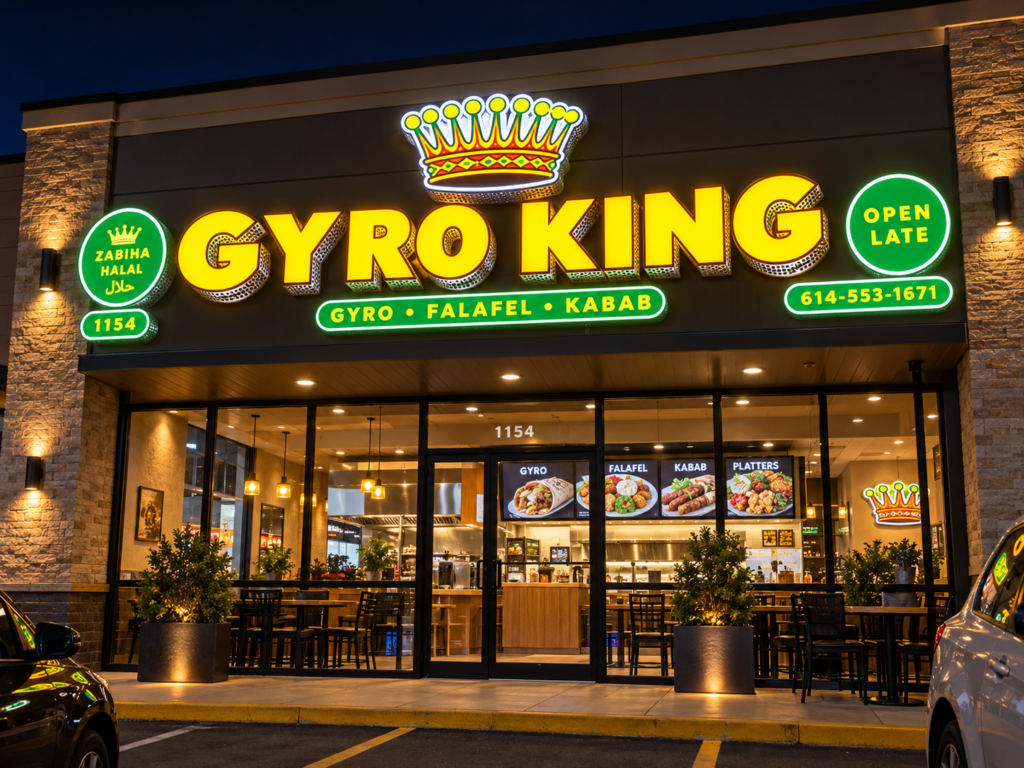
The project photographs show three useful stages: internal LED preparation, the fabricated GK logo components, and the completed sign undergoing a night illumination test. They also illustrate an important distinction: a decorative glitter or perforated metal side finish is not necessarily the same thing as a glitter-filled acrylic face. The materials, light path, and construction need to be considered separately.
The Gyro King Project: Glitter Stainless Steel Branding That Works at Street Level
Gyro King needed branding suited to a food business where customers often decide what to eat while passing the storefront. The main display features GYRO KING in warm golden-yellow illumination, a crown symbol above the name, a smaller food-category line, and round accents at either end. The words GYRO • FALAFEL • KABAB reinforce the offer, while the green elements bring an additional recognizable color into the composition.
The separate GK logo components echo the same identity. Their vivid yellow faces are outlined with polished-looking metal trim, while the deep sides contain a closely spaced decorative perforation pattern. This gives the letters a textured, dimensional effect rather than the appearance of ordinary flat-cut plastic.
A successful restaurant sign should tell customers three things quickly: whose premises they are looking at, what kind of business it is, and where the entrance or service point is. The Gyro King layout uses size and contrast to establish that order without filling every available inch with text.
Stage One: Preparing the Internal LED Letterwork
Producing dimensional illuminated lettering begins with the physical construction and electrical layout. Each letter is shaped to match approved artwork, then prepared to accommodate LED modules, electrical wiring, and a suitable return depth. Unlike a printed sign, the letters are individual manufactured objects. Their backs, sides, faces, and lighting systems must fit together accurately.
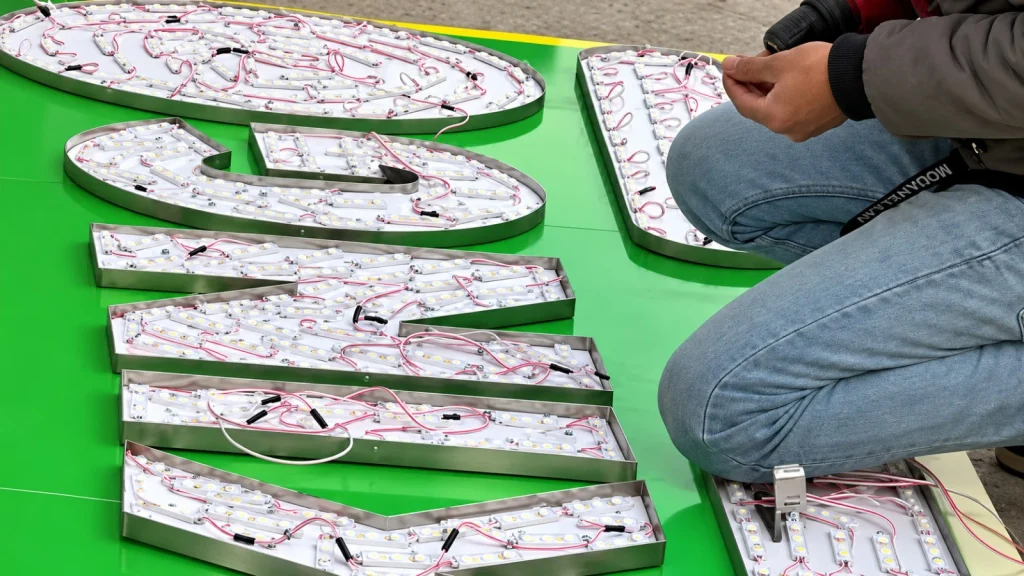
The fabrication photo shows the backs of several large letters with multiple small LED modules distributed across the interior. Wiring loops connect the modules, while the open construction allows the technician to inspect their placement. This is a useful reminder that the quality of an illuminated sign depends heavily on parts that customers will never see.
If the modules are spread too far apart, the acrylic face may show darker patches. If placed too close to the face, individual light points may become visible. Narrow letter strokes, rounded corners, and large open areas require different spacing. A good lighting layout responds to the actual geometry of the character rather than repeating the same arrangement everywhere.
Fabrication Decisions That Affect the Glow
The team must consider letter depth, internal reflectivity, LED power, face diffusion, and access for future repairs. Waterproofing or other environmental protection should match the intended installation. Electrical connections also need appropriate strain relief and secure routing, particularly when separate letters are shipped for installation elsewhere.
Workshop testing before final assembly helps uncover dead modules, inconsistent brightness, or wiring problems while they can still be corrected conveniently.
Why Glitter Stainless Steel Is Different From Ordinary Lettering
The term glitter stainless steel is often used commercially for premium fabricated sign letters with a reflective, textured, perforated, or sparkle-like side treatment. It is not one single universal manufacturing specification. Different sign makers may use stainless-steel returns, polished trims, decorative perforations, contrasting paints, or internal colored LEDs to create a similar visual effect.
For that reason, the best project specification states exactly what is being supplied: the metal grade, return thickness and depth, finish, face material, LED color, and whether the decorative side treatment itself emits or reflects light.
For the Gyro King components shown here, the eye-catching effect comes from the combination of colored letter faces, dimensional metallic trim, and patterned sides. The photographs suggest a decorative perforated-metal appearance, but a close-up alone cannot establish the exact alloy grade. That detail should be confirmed from the fabrication record rather than guessed from a photograph.
This distinction matters to buyers because the structural durability, finish maintenance, and electrical performance depend on what has actually been manufactured.
Stage Two: Completing the GK Letters and Crown
After the structural bodies are prepared, the front faces and visible side finishes are brought together. This is the stage where the brand’s physical character becomes clear. The logo components shown in the workshop include a yellow GK element and a crown-inspired top piece, both formed into substantial three-dimensional shapes.
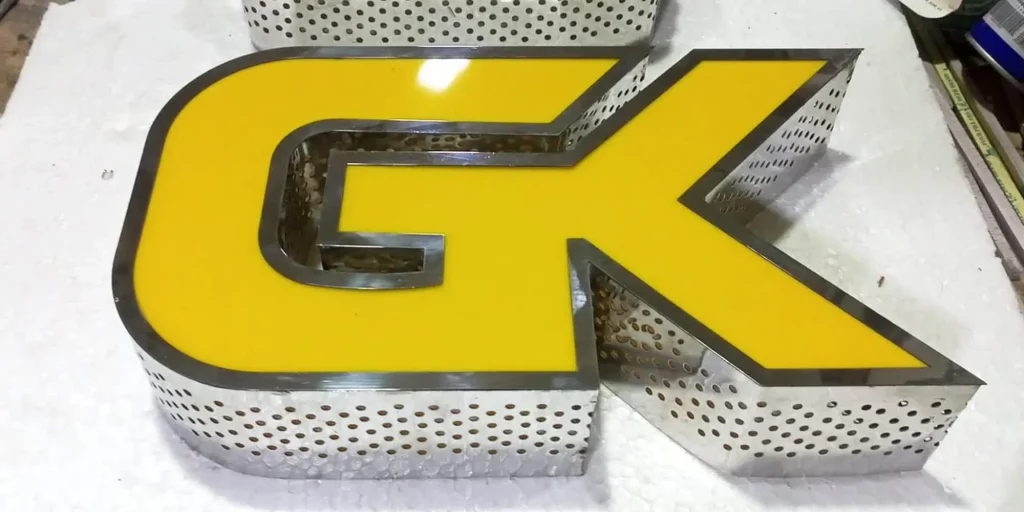
The yellow face of the GK symbol provides strong color recognition, while the silver-toned outline creates a clean boundary. Small openings across the metal sides give the structure its decorative finish. If this style is illuminated from within, the final appearance depends on how the openings, internal lighting, and side-wall construction are specified.
At this point, the fabrication team should check that the face fits evenly, the edges are free of sharp or uneven joins, and the decorative perforation remains consistent around the curves. The lettering must also look attractive with the LEDs switched off. A daytime sign still represents the business even when no illumination is visible.
The Importance of a Coordinated Logo
A main storefront name and a smaller logo mark should feel like members of the same design family. Matching colors, proportions, and material finishes helps customers connect the two. For restaurants, a compact crowned GK symbol can serve as a secondary identity on a counter, wall feature, takeaway area, or complementary sign without repeating the entire storefront name.
Stage Three: Switching on the Completed Sign
The strongest test of a commercial illuminated sign is how it looks under real low-light conditions. The night photograph shows the complete GYRO KING branding switched on, with warm yellow lettering, a bright crown, green circular accents, and smaller illuminated text. The scene demonstrates visibility and brand contrast rather than merely the physical shape of individual letters.
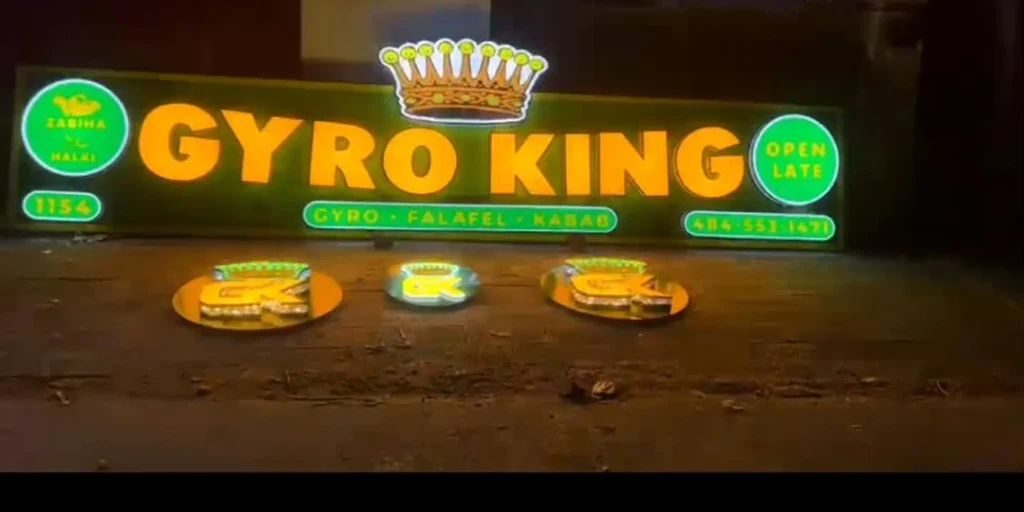
Large characters attract the eye first. The crown strengthens recognition, while the smaller food descriptors add context for a viewer standing closer to the sign. The surrounding colored elements help separate the identity from a dark background without competing with the main words.
The most useful night test checks more than whether each letter turns on. It also examines bright spots, dark corners, color consistency, power-supply behavior, and how the entire layout reads from different angles. If a sign is meant for a street-facing restaurant, the test should consider the probable viewing distance and ambient light around the finished location.
Choosing the Right Lighting Method for Glitter Stainless Steel Signs
Dimensional metal letters can be lit in several ways. In a front-lit sign, LED light passes through a translucent face, making the actual characters appear bright. Halo-lit letters instead project light behind an opaque character, creating a reflected glow around its edges. Dual-lit letters can combine those two effects.
Decorative perforated side returns introduce another possibility: light visible through small openings along the sides. This can create a sparkling impression, but it requires a deliberately planned internal lighting system and suitable weather protection. It should not be assumed merely because the metal has holes.
| Lighting style | Typical visual result | Useful application |
|---|---|---|
| Front-lit | Bright faces with easy-to-read characters | Restaurants and high-visibility retail |
| Halo-lit | Soft glow around solid letters | Offices, salons, premium storefronts |
| Dual-lit | Illuminated face plus rear outline | High-impact branding |
| Perforated-side effect | Decorative points or strips of side light | Custom logos and distinctive feature signs |
The right option comes from the business objective. A drive-by restaurant may prioritize direct readability, while an indoor feature logo can use more decorative effects at shorter viewing distances.
Materials, Finishes, and Durability of Glitter Stainless Steel Letters
Stainless steel is valued for its finish options and corrosion resistance, but performance varies by grade, fabrication method, and installation conditions. Grade 304 is commonly used in many commercial settings; more aggressive environments may require a different specification. Polished or brushed metal also needs careful handling so the finish is not marked during fabrication, packaging, or installation.
Front faces may be acrylic where illumination needs to pass through. Returns, backs, and trim may use stainless steel, aluminum, or other appropriate materials. Fasteners, adhesives, protective coatings, and electrical components are part of the overall durability calculation.
A polished-looking sign can still be poorly built if its internal components are not appropriate for the environment. Buyers should ask for clear material descriptions, lighting specifications, and drawings instead of relying exclusively on rendered images.
How Glitter Stainless Steel Letters Strengthen Restaurant Branding
Glitter stainless steel letters can be especially effective when a business wants a premium-looking emblem without sacrificing bold color. A reflective trim catches daylight, the raised profile produces natural shadows, and carefully planned LED illumination creates a second visual identity at night.
For Gyro King, the strong yellow fronts and decorative side treatment make the GK logo memorable even in a close-up. The main sign uses related warm colors and the crown motif, bringing the individual pieces into a consistent brand story. This kind of repetition builds recognition more effectively than adding unrelated visual effects to every part of a storefront.
The same principle applies to coffee shops, bakeries, fashion retailers, barbershops, convenience stores, and specialist restaurants. Materials should support a recognizable visual system, not distract from it.
Manufacturing Glitter Stainless Steel Signage for a USA Project
When signage is fabricated for a customer in the United States, the design must account for more than the finished look. Dimensions, electrical requirements, mountings, and packaging need to be coordinated with the installation team. The specific city or state can have its own sign permits and electrical rules, and some projects require listed electrical sign assemblies or licensed local installers.
Manufacturing overseas does not remove those requirements. The client and local contractor should establish the applicable approvals and specifications before fabrication is finalized. Clear technical drawings, circuit information, component labeling, and mounting templates can reduce confusion when the finished letters arrive.
Our Gyro King project photographs document manufacturing and testing; they should not be presented as proof of a particular US site installation unless an actual installed photograph is available.
Packaging, Shipping, and Installation Planning
Custom dimensional letters are vulnerable to scratches, pressure, and bending if packed carelessly. Decorative perforated returns also need protection because their edges and finish may be damaged by contact with neighboring components. Protective film, foam separators, rigid cartons, and properly designed crates can help preserve the sign during transportation.
Electrical components should be identified so the installation team knows which modules and power connections belong to each part. A detailed layout drawing is especially useful for multi-piece brand names and secondary logos.
At the installation stage, the structural backing and anchors must suit the building substrate. Outdoor signs should be checked for wind exposure, safe electrical routing, drainage where necessary, and practical access for repairs.
Frequently Asked Questions About Glitter Stainless Steel Letters
What Are Glitter Stainless Steel Letters?
Glitter stainless steel letters are a commercial signage style that combines dimensional metal lettering with a sparkle-like, textured, polished, or decorative side appearance. The term is used differently by manufacturers, so it is worth checking whether the effect comes from perforated returns, reflective finishes, illuminated holes, or another treatment. A specification should identify the metal grade, face material, finish, depth, and lighting method.
Can Glitter Stainless Steel Signage Be Used Outdoors?
Yes, provided the complete assembly is designed for exterior use. Suitable metal selection, protective finishes, electrical components, wiring, drainage, and secure mountings are important. Perforated or decorative sides should be evaluated carefully because openings can change how moisture and dirt enter the structure. The correct solution depends on local weather, building conditions, and the applicable electrical and sign regulations.
Are the Fronts Made From Stainless Steel or Acrylic?
Both constructions are possible, depending on the desired effect. A front-lit letter commonly has a translucent acrylic face, allowing light to pass directly through it. An opaque stainless-steel face is more typical of certain halo-lit designs. The visible GK components in this project have bright yellow faces and metallic-looking trim, but exact material composition should be verified against the production specification.
Why Do Fabricators Test LEDs Before Installing the Faces?
Open-letter testing allows technicians to see the positioning of the LED modules and inspect the wiring connections. Uneven spacing, disconnected modules, or unexpected dark areas can be corrected before final assembly. A second test with the faces fitted confirms the appearance customers will actually see. Both steps can reduce installation problems and make quality control more efficient.
How Can a Restaurant Choose Its Letter Size?
Start with the normal viewing distance, traffic movement, sign height, and available facade width. Prioritize the restaurant name, then add only the most useful supporting wording. Large letters with strong contrast are generally easier to read from the road than tightly packed text. A full-size layout or realistic scale mockup helps confirm proportions before any material is cut.
Can Custom GK-Style Signs Be Shipped Internationally?
Yes. Custom metal and acrylic lettering can be made to approved specifications and packed for overseas delivery. The key is coordination: confirm the electrical standard, mounting details, packaging dimensions, local sign rules, and any necessary certifications before production. Clear labels and drawings help installers assemble the components in the correct order and reduce the risk of damage during handling.
How Much Maintenance Do Illuminated Metal Letters Require?
Maintenance varies with the environment and component quality. Periodic cleaning helps maintain the visible finish, while electrical issues should be inspected by qualified personnel. Outdoor signs may need additional attention after severe weather or exposure to dust and moisture. A serviceable design, correctly sized power supplies, and good cable protection generally make long-term maintenance more manageable.
Final Thoughts: Glitter Stainless Steel Signage That Stands Out Day and Night
The Gyro King project shows how thoughtful construction, identifiable colors, dimensional logo pieces, and careful LED testing can turn a restaurant name into a recognizable visual system. The production photographs highlight the less visible steps that make the finished result possible: letter assembly, decorative metalwork, internal LED placement, and illumination checks.
For businesses seeking distinctive, durable-looking storefront branding, glitter stainless steel can provide a compelling aesthetic when the material and lighting specifications are chosen carefully. The most effective sign is not simply the brightest or most elaborate one; it is the one customers can recognize quickly, read comfortably, and associate with a consistent business identity.